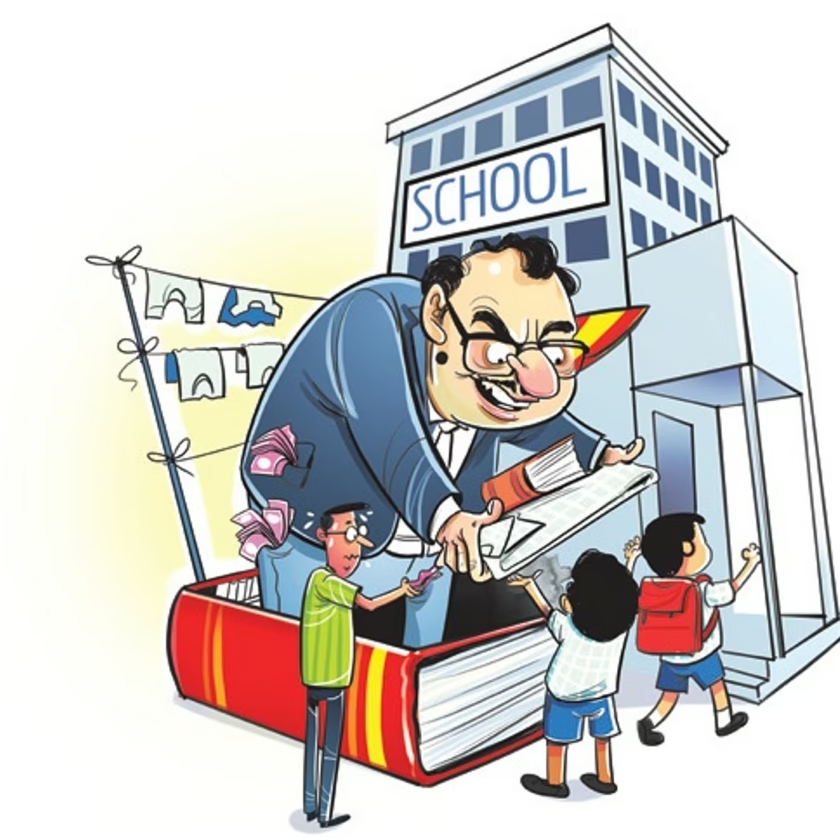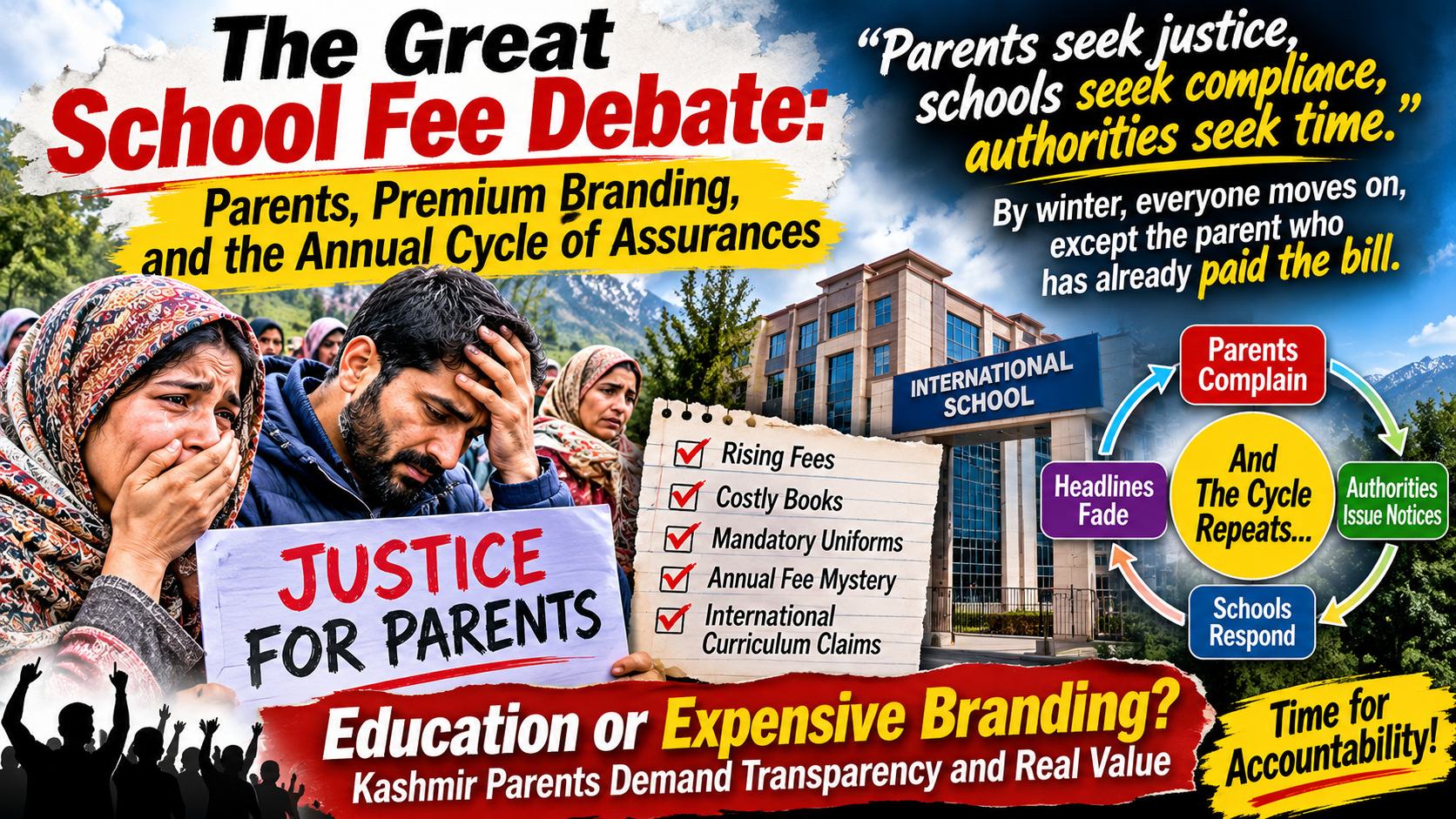
From costly book sets and annual charges to international-school branding and a regulator without a chairperson, the dispute is no longer simply about how much parents pay. It is about what they receive, what schools are permitted to charge, and why enforcement so often arrives after families have already paid.
News Feature | November 10, 2026
Parents seek justice, schools seek compliance, authorities seek time. By winter, everyone moves on, except the parent who has already paid the bill.
Every new academic session in Kashmir brings a familiar financial calculation for thousands of families. There is the monthly tuition fee, the annual charge, the transport bill, the new booklist, uniforms, shoes and, in some cases, additional payments for activities, technology and other facilities.
For parents, the expenses do not arrive separately in their household budgets. They arrive together.
Schools, meanwhile, defend their fee structures by pointing to salaries, infrastructure, electricity, transport, maintenance and the cost of providing what they describe as quality education. The authorities issue circulars, constitute committees and promise action.
Then the immediate controversy fades.
The school year moves forward, parents continue paying, and the same questions return when the next fee card arrives.
The latest controversy has once again brought the issue into focus. On November 9, Education Minister Shameema Firdous said the government would examine complaints against private schools, including reports of book sets costing between ₹7,000 and ₹10,000 and pressure on parents to purchase uniforms from designated sources. She promised a meeting with education officials and said an order would follow consultations.
It was an important acknowledgement of parental concerns. But it also raises a familiar question: how many more announcements will it take before families see measurable relief?
The deeper problem is not that every private school is exploiting parents or that every high fee is unjustified. Private institutions have legitimate expenses and a legal right to charge reasonable fees. The problem is the distance between what the law permits, what schools actually collect and what parents can independently verify.
A fresh promise, an old pattern
The minister’s November 9 remarks have revived a debate that has continued through several academic sessions.
According to the report published by Hindustan Times, Firdous said she had received reports of private schools selling book sets for ₹7,000 to ₹10,000. She also expressed concern about schools insisting that parents purchase uniforms from particular sources.
The minister did not name individual schools, publish an official price survey or provide an itemised comparison of the books included in those sets. Her statement should therefore be understood as an account of complaints received by the government, not as an independently verified finding against every private school.
That distinction matters. A book package may contain textbooks, workbooks, supplementary readers and other materials. The price needs to be examined title by title, publisher by publisher and grade by grade. A broad allegation cannot replace an itemised investigation.
But the minister’s remarks also create an expectation. If the government has received complaints, parents should be told what happens next.
Will schools be asked to publish complete booklists? Will publishers and editions be disclosed? Will parents be allowed to purchase the same books from the open market? Will schools be required to explain why particular supplementary material is necessary?
Most importantly, will the government publish the order it has promised?
A statement of intent is not an enforceable direction. Parents have heard assurances before. This time, they need a clear procedure, a deadline and visible action.
The law exists. The problem is enforcement.
It would be inaccurate to suggest that Jammu and Kashmir has no legal framework for regulating private-school fees.
The relevant legislation is the Jammu and Kashmir School Education Act, 2002, which was amended in 2020 to insert Sections 20A to 20J and establish a statutory Fee Fixation and Regulation Committee, commonly known as the FFRC.
The government subsequently notified the Jammu and Kashmir Private Schools (Fixation, Determination and Regulation of Fee) Rules, 2022, through S.O. 233 dated May 10, 2022.
Some news reports have loosely referred to a School Education Act of 2022. The distinction is important: the principal Act is from 2002, while the detailed fee-regulation rules were notified in 2022.
The law gives the FFRC powers to examine school fee proposals, approve fee structures, hear complaints of overcharging and take action when schools violate its directions.
What can a private school legally charge?
Section 20E of the Act identifies the permissible categories of fees. These include:
- Tuition fee.
- Annual fee.
- Transport fee.
- Voluntary special-purpose charges, such as picnics, tours and excursions.
- Any other fee specifically approved by the FFRC under the prescribed procedure.
The same provision prohibits private schools from charging admission fees or collecting other amounts under different names to get around the law.
This is an important distinction. A school cannot simply invent a new fee head, print it on a payment slip and expect parents to accept it as a lawful charge.
If a school introduces a development fee, activity charge, technology fee or another payment, parents are entitled to ask whether that particular charge is included in the approved fee structure.
The government also told the Legislative Assembly in March 2026 that private schools cannot fix, collect or increase fees without prior formal approval from the FFRC. It said the committee considers financial audits, infrastructure, location, maintenance expenses, student strength, academic performance and the reasonable surplus required for development.
The legal framework, therefore, does not give schools unlimited freedom to decide what parents must pay.
Nor does it require every school to charge the same amount.
Why can schools increase fees every year?
This is one of the most common questions raised by parents.
The answer lies in Rule 6 of the 2022 Fee Rules.
The fee determined by the FFRC is binding on the school and remains valid for three years. If the school wants a modification during that period, it must apply to the committee.
This means a school cannot simply announce an independent annual increase because the new academic session has begun or because its management believes expenses have risen.
There is, however, an important qualification. A fee order may contain a pre-approved schedule showing different amounts for successive years. If those increases have already been approved by the FFRC, they are different from an unauthorised hike announced by the school.
For example, an FFRC order dated February 25, 2026, concerning Public Educational Trust Model School, Ari Mendhar, Poonch, approved a fee schedule covering the 2026-27, 2027-28 and 2028-29 sessions. The order considered the school’s audited revenue and expenditure, infrastructure, maintenance costs, staff salary obligations, student-teacher ratio and other factors.
The order also approved different annual-fee amounts for new entrants in different classes and years.
This is how a fee increase should work: a school submits its financial information, the regulator examines the proposal and an approved structure is communicated.
The school cannot replace that process with an unexplained increase on a new fee card.
The annual fee: what exactly are parents paying for?
The annual fee has become one of the most confusing parts of the private-school bill.
Parents are often told that it covers maintenance, infrastructure, libraries, laboratories, smart classrooms, technology, development or other facilities. But the explanation is not always accompanied by a clear breakdown.
The law recognises annual fee as a permissible category. It does not, however, establish one universal annual-fee amount for every school or prescribe a single fixed purpose that applies identically to all institutions.
The amount must form part of the school’s approved fee structure. The FFRC is required to indicate the different heads under which fees may be levied and examine the school’s financial position and facilities.
The 2026 Ari Mendhar order offers a useful example. For that particular school, the committee approved an annual fee of ₹400 for new entrants from LKG to Class 8 for 2026-27, with a pre-approved increase to ₹450 in 2027-28 and ₹500 in 2028-29. It also approved a separate one-time annual fee for new Nursery entrants.
These figures are not a benchmark for other schools. They demonstrate that annual fees can be class-specific and school-specific, and that the regulator can examine how they are structured.
The order also directed the school not to sell books or uniforms on its premises, prohibited tie-ups with specific vendors, required the approved fee structure to be displayed on the notice board and website, and directed the management to ensure reasonable annual salary increases for employees.
The larger question is why parents in many cases are not given equally clear information.
Why does it feel like a 13th or 14th month?
Consider a family paying tuition every month for twelve months. At the beginning of the session, it is also asked to pay an annual fee. Transport, books, uniforms and other expenses come on top.
From the parent’s point of view, the annual fee can feel like an additional month of tuition. Where other charges are added, the total burden can resemble the cost of a thirteenth or even fourteenth month.
The comparison may not be a precise accounting description, but it captures the financial pressure families experience.
The correct question is not whether annual fees should exist at all. The question is whether the amount has been approved, what the approved order says it covers, whether the school has justified it through its accounts and whether parents are being charged anything beyond that approval.
A school should not be able to answer every question with the phrase “annual development charges”.
If the money is being collected for infrastructure, maintenance, laboratories or other facilities, parents should be able to see the approved fee head and the basis on which the amount was determined.
If fees range from ₹1,500 to ₹15,000, why the outrage?
A common argument in defence of private schools is that families have choices.
Some institutions charge relatively modest monthly fees. Others charge considerably more. The range of ₹1,500 to ₹15,000 often mentioned in public discussion illustrates the difference between low-cost, middle-range and premium institutions. It should not, however, be treated as an official district-wide fee survey.
The argument is that parents are free to choose a school according to their financial capacity. If an institution offers better infrastructure, trained teachers, laboratories, technology, transport and other facilities, it should be able to charge more.
There is a legitimate point here.
The High Court addressed this issue in its January 28, 2026 judgment in New Convent High School and Others v. Union of India and Others. The court recognised the role of private schools and held that institutions must have room to determine a reasonable fee structure. It also recognised that schools need funds to pay teachers, maintain infrastructure and develop facilities.
The court made it clear that the law does not require private schools to operate on a no-profit, no-loss basis. A reasonable surplus for the development of the institution is permissible. What is prohibited is profiteering and commercialisation of education.
The court also said the FFRC should not attempt an extensive examination of every school in the Union Territory. With more than 5,000 private institutions, it would be impractical to scrutinise every fee proposal in equal detail. The committee should develop a rational process for selecting cases for detailed examination, particularly large urban institutions, while also acting on specific complaints from parents and other stakeholders.
This is an important balance.
A school charging ₹15,000 is not automatically guilty of profiteering. A school charging ₹1,500 is not automatically providing poor education. The amount alone cannot establish whether the fee is fair.
The relevant questions are whether the fee has been approved, whether the school’s facilities and academic performance justify it, whether its accounts support the proposal and whether it is collecting anything beyond the approved structure.
The real controversy is not the difference between a low-cost and a premium school. It is the difference between the price advertised and the educational value delivered.
International branding, local accountability
The debate becomes more serious when schools market themselves as international institutions.
Words such as “International School”, “Global Education”, “World-Class Learning”, “Cambridge Curriculum” and “Smart Learning Environment” create expectations.
Parents naturally associate these labels with better teaching, modern classrooms, trained staff, international exposure and improved academic outcomes.
But a name on a school gate is not proof of educational quality.
A school using international branding should be able to explain exactly what it means. Is it affiliated with a recognised international examining body? Does it follow a formally approved programme? Which classes are covered? What qualifications do its teachers hold? Have teachers received training in the curriculum being advertised?
The questions are particularly important because the law already sets minimum requirements for teaching staff.
Section 19 of the J&K School Education Act, 2002, states that the academic and other qualifications of teaching and non-teaching staff in private schools cannot be lower than those prescribed for corresponding government posts.
For CBSE-affiliated schools, the requirements go further. The CBSE Affiliation Bye-Laws provide for minimum teacher qualifications and annual professional-development programmes. Under Clause 16.1, schools must arrange three days of in-house training for each teacher and at least two additional days of training, preferably through recognised training institutions or the Board’s Centres of Excellence.
CBSE’s requirements also provide for annual school reports containing information about teachers’ qualifications, training, academic achievements and other institutional details.
These are not decorative requirements. They are part of maintaining educational standards.
A school that charges premium fees should be prepared to demonstrate that its teaching standards justify the price.
If it advertises an international curriculum but cannot show the relevant teacher preparation, subject expertise or classroom delivery, parents have a reasonable basis to question the claim.
A smart board does not automatically produce smart learning. Imported books do not automatically create international standards. A glossy brochure cannot replace qualified teachers.
The analogy is simple: a school cannot market itself as a Mercedes and expect parents to accept an ordinary service simply because the logo looks expensive.
Who decides the curriculum and textbooks?
The textbook controversy is not merely a question of personal preference. It also involves the legal obligations attached to a school’s affiliation.
In December 2023, JKBOSE issued Notification No. F (Acad-C)/E-File-7318285/TXT/BK-XIV/23, directing affiliated private schools to implement the Board’s prescribed curriculum and textbooks for Classes 1 to 12 from the 2024-25 academic session.
The notification also directed that no school should force parents or students to purchase books or other material outside those published and prescribed by JKBOSE.
This is relevant to schools affiliated with JKBOSE. Schools affiliated with other recognised boards must follow the curriculum and textbook requirements of their respective affiliating bodies.
The legal position received further support from the High Court on June 6, 2026, in J&K Private Schools United Front v. Union Territory of J&K, LPA No. 241 of 2023.
The Division Bench dismissed the appeal challenging JKBOSE’s authority to prescribe textbooks for affiliated private schools. The case specifically concerned the Board’s directions for Classes VI to VIII. The court held that once an institution voluntarily obtains affiliation, it must comply with the conditions governing that affiliation, including the prescribed curriculum, syllabus and textbooks.
The distinction is important: the June judgment concerned the Classes VI to VIII notifications under challenge. The wider direction for Classes 1 to 12 came through JKBOSE’s separate December 2023 notification.
For parents, the practical point is straightforward. A school cannot use the phrase “our own curriculum” as a blanket justification for prescribing any book it chooses.
If it wants to use supplementary material, it should explain the academic purpose, the status of that material under the relevant board’s rules and whether parents are being compelled to purchase it.
The vendor question
Parents have repeatedly raised concerns about designated bookshops, changing booklists, expensive uniform sets and alleged commercial arrangements between schools and suppliers.
These complaints should not automatically be treated as proof of wrongdoing by every institution. Some changes in books and uniforms may have genuine academic or practical reasons.
But the issue is serious enough to require transparency.
The FFRC’s February 25, 2026 order for Public Educational Trust Model School, Ari Mendhar, specifically prohibited the school from selling books and uniforms on its premises and from maintaining tie-ups with particular vendors. It directed that parents should remain free to purchase from the open market.
A similar restriction appears in an FFRC order concerning Modern Institute, issued on February 20, 2026.
These are school-specific conditions, not proof that every institution is governed by an identical vendor prohibition in the same wording. But they demonstrate that the regulator can address the risk of commercial arrangements through clear conditions in its orders.
The government should now publish a uniform, easily understood policy on booklists, uniform purchases, vendor relationships and the right of parents to shop independently.
The notice trail: action announced, outcomes harder to find
The FFRC has not been entirely inactive. Its official records contain notices, circulars and school-specific fee orders.
But the difference between issuing a notice and enforcing it is where the real accountability question begins.
Consider two major notices.
October 13, 2025: The FFRC issued an order concerning 781 private schools in the Kashmir division that had failed to submit the required documents for regulation and determination of tuition and annual fees. The committee directed these schools to stop collecting fees until formal approval or the required clearance was obtained.
March 5, 2026: The FFRC issued a final 15-day notice to 660 private schools in the Kashmir division for failing to submit their fee-regulation files despite earlier communications.
These figures should not be added together to claim that 1,441 separate schools were involved. The two official lists overlap substantially. The March notice appears to concern continuing non-compliance after earlier communications.
There is another important distinction: these notices concerned the failure to submit fee-regulation documents. They do not establish that every school named had been found guilty of charging excessive fees or making illegal profits.
The notices warned of restrictions and other action. What parents need now is a public account of what happened afterwards.
How many schools submitted their files? How many received approval? How many were actually restrained from collecting fees? How many were fined? How many parents received refunds?
The notices establish that the regulator identified a compliance problem. They do not, by themselves, establish the final enforcement outcome.
The government formed another committee
On January 20, 2026, the School Education Department issued Government Order No. 33-JK (EDU) of 2026, constituting a committee under the chairmanship of the Secretary, JKBOSE.
The committee was asked to examine whether private-school fees and the costs of books, uniforms, shoes and other items were based on verifiable and justifiable parameters.
It was also asked to examine the legal basis for charging transport fees during winter vacations in Kashmir.
The committee was given 30 days to submit a detailed report.
The order was a recognition that the controversy extended beyond tuition fees. But in the public material reviewed for this feature, a final report or a detailed government statement explaining its findings could not be located.
That leaves another question unanswered.
What did the committee discover? Did it find that some charges lacked a proper basis? Did it recommend changes to booklists, uniform policies or transport fees? Were its recommendations accepted?
A committee’s formation is not the same as a solution. Its findings must be made public.
The FFRC without a chairperson: the biggest enforcement gap
Perhaps the most serious development in the fee-regulation story is the leadership vacuum inside the FFRC.
Justice (Retd) Sunil Hali was appointed chairperson in March 2023 for a three-year term. The government extended his tenure by one month after the original term ended on March 31, 2026. The extension expired on April 30.
In a report published on October 12, Greater Kashmir said the committee had been functioning without a chairperson for more than five months. An official told the newspaper that the FFRC could receive applications and examine documents but could not approve fee structures or take effective action on complaints without the chairperson.
The backlog figures reported by local media have not been consistent. Rising Kashmir reported on August 20 that nearly 1,200 applications and files were awaiting clearance. The later Greater Kashmir report referred to hundreds of pending files without giving a precise figure.
The government should publish one verified number rather than leave parents and schools to rely on differing estimates.
The vacancy also has a legal dimension.
In its January 28, 2026 judgment in the New Convent High School case, the High Court held that the FFRC must be headed by a retired High Court judge nominated by the Chief Justice of the High Court of Jammu and Kashmir and Ladakh. The court ruled against the provision allowing a retired government officer of Financial Commissioner rank or above to head the committee.
The judgment did not abolish the FFRC or invalidate the entire fee-regulation framework. It upheld the statutory mechanism while requiring the chairperson provision to be brought in line with Supreme Court directions.
The court also asked the government to revisit the 2022 Fee Rules and introduce clearer parameters so that the committee could prevent profiteering without unnecessarily interfering in genuine private schools, particularly smaller rural institutions.
As of the latest public report that could be independently verified for this feature, dated October 12, the chairperson’s post remained vacant. No later official appointment notification was located in the records reviewed up to November 10.
This is more than an administrative delay.
The 2022 Rules provide for complaints by parents and guardians. Rule 16 says complaints should be disposed of as early as possible, preferably within 45 days. Rule 12 also provides for refunds when excess fees have been established, with the refund to be made within 30 days of the relevant direction.
When the authority responsible for deciding these disputes cannot function effectively, parents are left with a rulebook but no timely remedy.
The High Court also clarified that complaints about overcharging, including transport fees, should be dealt with by the FFRC rather than being diverted to other government authorities in matters that fall squarely within the committee’s jurisdiction.
The leadership vacancy therefore creates a serious gap in the very mechanism the law was designed to provide.
A legal detail the authorities should clarify
The March 5, 2026 notice to 660 schools refers to Section 20-G of the Act as the basis for fines ranging from ₹50,000 to ₹1 lakh for repeated offences.
There is an apparent inconsistency in that citation. The January 2026 High Court judgment reproduces Section 20-G as the provision dealing with the staff of the FFRC. The 2022 Fee Rules separately set out an enforcement mechanism under Rule 12, including escalating fines of 1%, 3% and 5% of the school’s previous-year revenue for repeated non-compliance with committee directions.
This does not, by itself, establish that the entire notice is invalid. It does mean the government should clarify the exact statutory provision and penalty applicable, so that parents and school managements are not left relying on conflicting legal references.
A regulator expected to enforce compliance must also ensure that its own notices are legally precise.
Schools have a case too, and it deserves to be heard
A fair investigation cannot assume that every private school is profiteering.
Schools have real operating expenses. Teachers and non-teaching staff must be paid. Buildings require maintenance. Electricity, heating, transport, insurance, equipment and safety measures cost money. Institutions in rural areas may operate with smaller student numbers and limited financial resources.
In the January 2026 High Court case, private-school petitioners argued that increases in fuel prices, insurance, road taxes, maintenance costs and staff salaries had not been adequately reflected in transport charges and other fee decisions.
The court recognised that private institutions have a right to reasonable financial autonomy and may generate a reasonable surplus for the development of their institutions. It also cautioned that a rigid, uniform fee structure would fail to account for differences in location, facilities, student strength and operating costs.
That is a necessary part of the debate.
A small rural school should not automatically be treated like a large premium institution in Srinagar. Nor should a school that has invested in laboratories, libraries, trained teachers and modern facilities be expected to charge the same amount as an institution with minimum infrastructure.
But financial autonomy must come with financial accountability.
A school seeking higher fees should submit proper accounts, explain its costs and demonstrate the facilities and academic standards used to justify its proposal. A school cannot use rising expenses as a permanent, unexplained reason for increasing fees.
Reasonable surplus is permitted. Profiteering is not.
The parent’s choice is real, but it is not always simple
Another argument often heard is that parents should simply move their children to a less expensive school.
In theory, the market offers choices. In practice, changing schools is not always straightforward.
Parents consider the distance from home, transport arrangements, language of instruction, safety, examination results, peer groups, teaching standards and the child’s ability to adjust to a new environment.
A child who has spent several years in one institution cannot always be moved without disruption. Parents may also believe that a school with a polished campus, English-speaking environment and international branding offers better opportunities, even when they cannot independently measure the quality of teaching.
This creates an information gap.
Parents can see the building, uniforms and advertisements. They cannot easily inspect the school’s audited accounts, teacher salaries, staff turnover, classroom practices or the actual use of technology.
That is why consumer awareness alone cannot solve the problem.
Parents should make informed choices, but the regulator must make meaningful information available.
A school should not be able to sell an image of excellence while leaving the evidence of that excellence inaccessible.
What needs to change before the next academic session?
The debate has produced enough circulars, meetings and assurances. The next stage must be about results.
1. Appoint the FFRC chairperson without further delay. The appointment must follow the January 28 High Court judgment, including the requirement of a retired High Court judge nominated by the Chief Justice.
2. Publish a school-wise fee database. Parents should be able to search a school’s approved tuition, annual and transport fees, the classes covered, the date of approval and the period for which the order remains valid.
3. Make fee orders visible. Every school should display its current approved fee order on its notice board and website. Parents should not have to visit several offices to discover what they are legally required to pay.
4. Explain the annual fee. Schools should identify the approved annual-fee head, the classes to which it applies and whether a separate amount applies to new entrants.
5. Release the January committee report. The government should publish its findings on fees, books, uniforms, shoes and winter transport charges, or explain why the report has not been released.
6. Publish the outcome of the 781 and 660 school notices. The public needs to know which institutions complied, which received approvals and which faced actual restrictions or penalties.
7. Make booklists transparent. Schools should publish the prescribed books, publishers, editions and prices before admissions and explain the academic need for supplementary material.
8. Disclose teacher qualifications and training. Schools making premium academic claims should provide verifiable information about their teaching staff, professional development, student-teacher ratios and academic performance.
9. Protect parents who complain. A confidential grievance mechanism and protection against retaliation would encourage families to report violations without fearing consequences for their children.
10. Strengthen government schools. Private education will continue to attract families as long as parents believe that government institutions cannot meet their expectations. Improving public schools is not separate from regulating private schools. It is part of the solution.
What parents can check before paying
Parents do not need to become legal experts to ask basic questions.
- Request the school’s current FFRC-approved fee order and compare it with the fee card.
- Check that tuition, annual and transport charges are separately identified.
- Ask whether an annual-fee increase is part of an approved multi-year schedule or a new modification.
- Request itemised receipts. The FFRC has directed schools to clearly mention different fee heads in receipts.
- Ask for the complete booklist, including publisher, edition and price.
- Confirm which board the school is affiliated with and whether its prescribed curriculum is being followed.
- Ask whether transport is owned and operated by the school or outsourced, particularly when vacation charges are demanded.
- Keep copies of old and new fee cards, receipts, booklists and written messages.
- For fee-overcharging complaints, submit a written complaint to the FFRC and keep proof of submission. For curriculum or textbook violations, approach JKBOSE or the relevant affiliating board.
The FFRC has previously directed schools not to charge admission fees or disguised security deposits. It has also issued directions on advance fee collection and late-fee practices. Parents should check the applicable circular rather than rely on verbal explanations from school offices.
One further caution: a school’s appearance on the 781-school or 660-school notice lists relates to the failure to submit fee-regulation documents. It should not automatically be presented as proof that the school was found guilty of overcharging.
The question is no longer whether rules exist
Private schools have become an important part of Jammu and Kashmir’s education system. They employ teachers, educate large numbers of children and provide options that many families actively seek.
Their right to charge reasonable fees should be respected. Their financial needs should not be dismissed. But the responsibility to provide education also demands transparency, professional standards and compliance with the law.
Parents are not asking every school to charge the same fee. They are not demanding that private institutions operate without resources or reasonable surplus.
They are asking for something much simpler: if a school charges more, it should be able to show why. If it prescribes a curriculum, it should have the trained staff to deliver it. If it advertises international standards, it should be able to demonstrate them. If it collects an annual fee, it should show that the amount is approved.
And if the government promises action, parents should be able to see what that action has achieved.
The High Court has clarified the balance between school autonomy and protection against profiteering. The law provides for approved fee structures, audited accounts, refunds and complaints. The regulator has issued notices and individual orders. The Education Minister has now promised fresh measures over books and uniforms.
What remains is to connect these pieces into a system that works before the money leaves the parent’s pocket.
Because a circular issued after a fee has been collected is not the same as relief. A committee constituted without a published report is not the same as accountability. And a promise to act is not the same as an order enforced.
The cycle will continue until the government measures success not by the number of notices issued, but by the number of complaints resolved, unauthorised charges stopped and families actually refunded.
Parents seek justice. Schools seek clarity. Authorities seek time. But the school bill does not wait for winter to pass.
Frequently Asked Questions
Can private schools in Kashmir increase fees every year?
Not on their own. Under Rule 6 of the J&K Private Schools (Fixation, Determination and Regulation of Fee) Rules, 2022, an FFRC-approved fee structure remains valid for three years. A school seeking a modification must apply to the committee. A multi-year schedule may include pre-approved increases for successive years.
Is an annual fee illegal?
No. Section 20E of the J&K School Education Act, 2002, recognises annual fee as a permissible category. However, the amount must be part of the approved fee structure. Admission fees and other unauthorised charges are prohibited.
Can a school force parents to buy books from a particular shop?
JKBOSE-affiliated schools have been directed to follow the Board’s prescribed curriculum and textbooks, and not force parents to purchase other material. Some FFRC school-specific orders have also expressly prohibited vendor tie-ups and required parents to retain the freedom to buy books and uniforms from the open market.
Can a private school charge transport fees during winter vacations?
The FFRC’s February 2026 direction says schools may charge 50% of the transport fee during vacations where the transport facilities are owned and operated by the school. Where transport is outsourced or hired from third parties, no vacation transport fee should be charged under that direction, and amounts collected in violation should be refunded.
What should parents do if the FFRC chairperson’s post is vacant?
Parents can submit a written complaint to the FFRC and retain proof of submission. However, local reporting in October 2026 said the committee was unable to take effective decisions without a chairperson. Parents should also direct curriculum and textbook complaints to JKBOSE or the relevant affiliating board.
Are schools named in the 781 and 660 notices guilty of overcharging?
Not necessarily. The notices concerned failure to submit fee-regulation documents. They are not, by themselves, findings that every school on the lists overcharged parents or made unlawful profits.